Mariko Mori burst onto the art scene in the 1990s in the guise of a cyborg. Today, she speaks of the Jōmon period, the cosmos, and light.
Walking through Mariko Mori: All That Shines, her first major solo exhibition in Japan in 24 years, a common thread emerges among seemingly disparate works: an exploration of the boundaries of what it means to be human. What accounts for the sense of reassurance that lingers after viewing the exhibition, and the unease that accompanies it?
INDEX
Thirty Years On, the Future Still Looks Familiar
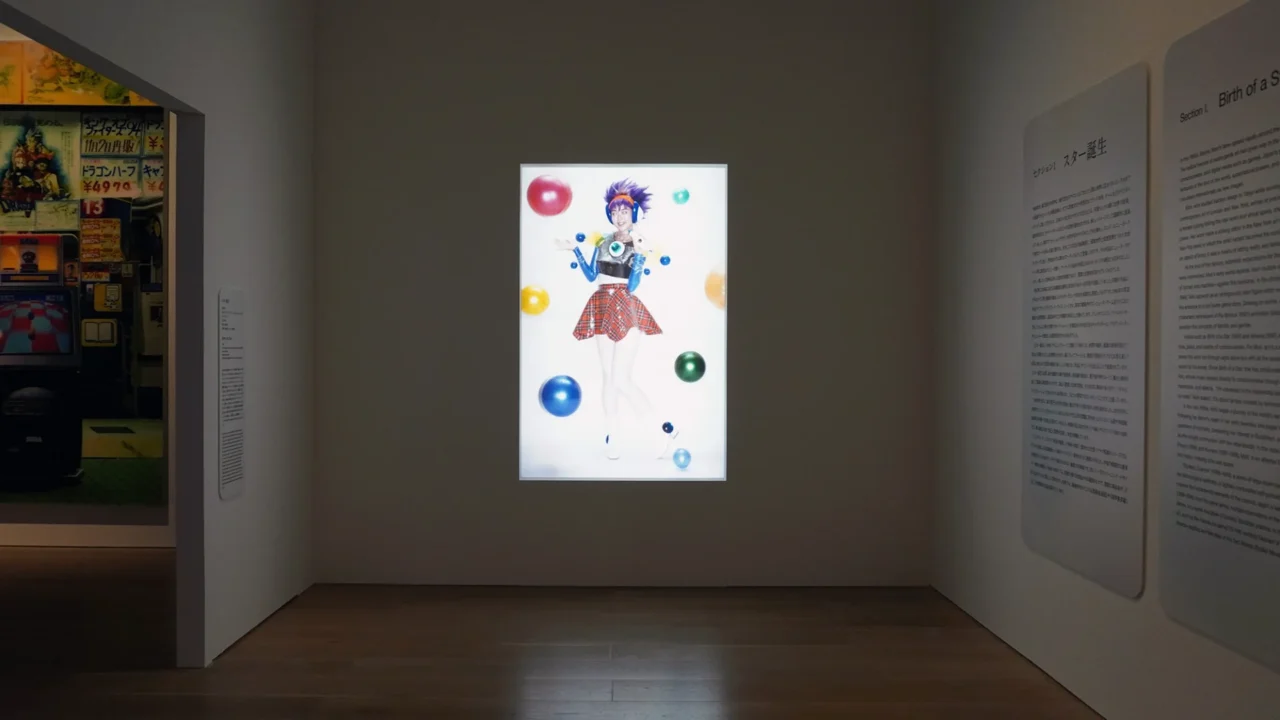
Step into the dimly lit galleries of the Mori Art Museum, and figures resembling anime characters or cyborgs emerge against a vibrant, pop-inspired backdrop. This is Birth of a Star (1995), glowing from within the wall as electronic music by Ken Ikeda plays softly in the background.
Mariko Mori: All That Shines marks the artist’s first major solo exhibition in Japan in 24 years, following Mariko Mori: Pure Land at the Museum of Contemporary Art Tokyo in 2002. Bringing together 40 works from the mid-1990s to the present, the exhibition traces more than three decades of Mori’s artistic practice.
Born in Tokyo in 1967, Mori studied fashion design before pursuing contemporary art in London and New York. She quickly rose to prominence with works such as Birth of a Star and her “Cyborg” series, gaining further international recognition with an honorable mention at the Venice Biennale in 1997. Her early works drew acclaim for their engagement with anime and video game culture, as well as their critical examination of how women are commodified in Japanese society.
Up close, Birth of a Star takes on an almost three-dimensional quality, its figures seemingly suspended in white light. The effect is achieved through 3D Duratrans, a photographic technique used in advertising to bring images to life through backlighting. Seen today, the effect feels somewhat nostalgic. Throughout her career, Mori has worked with the cutting-edge technologies of each era.
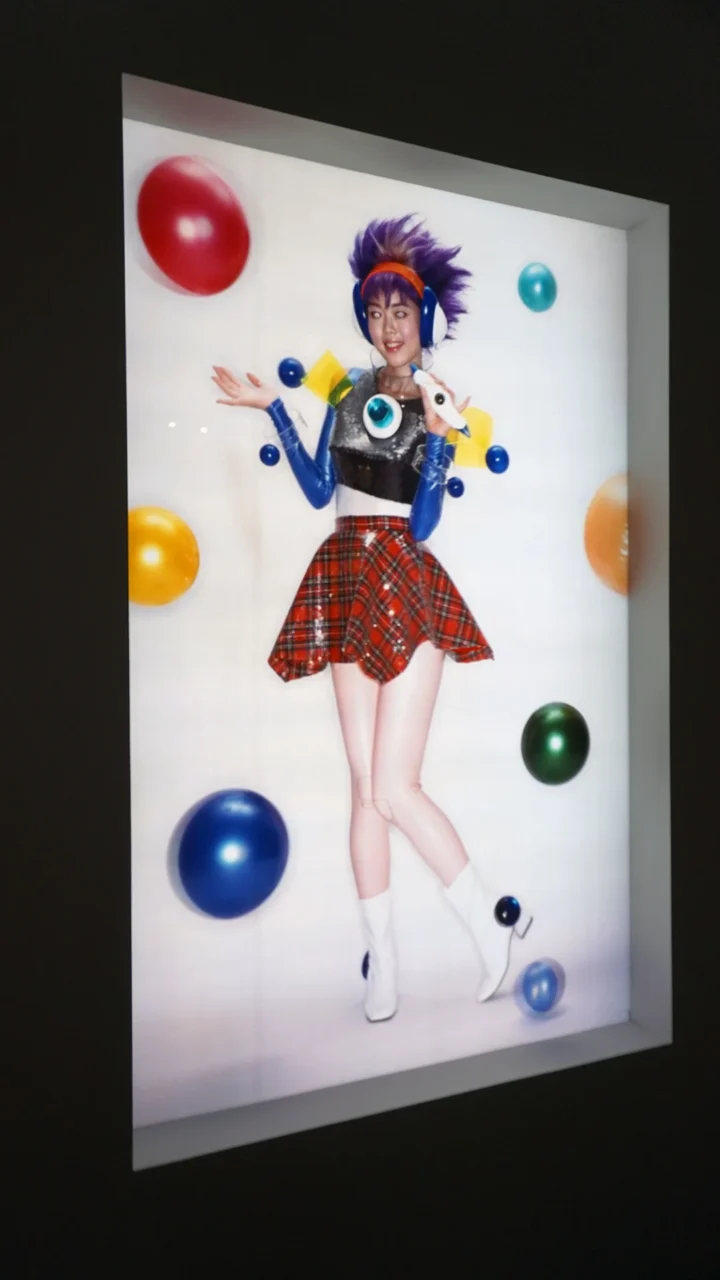
Alexandra Munroe, a curator at the Solomon R. Guggenheim Museum and Foundation who co-curated the exhibition with Mori Art Museum Director Mami Kataoka, notes that Mori already presents herself as a pop icon in Birth of a Star, portraying herself as a being beyond the human. She is both a woman and something akin to a cyborg. A decade earlier, in 1985, Donna Haraway had published her essay “A Cyborg Manifesto,” amid growing discussions about the boundaries between humans and machines, among others. The image of a body extended through technology could be seen as the starting point of Mori’s artistic practice.
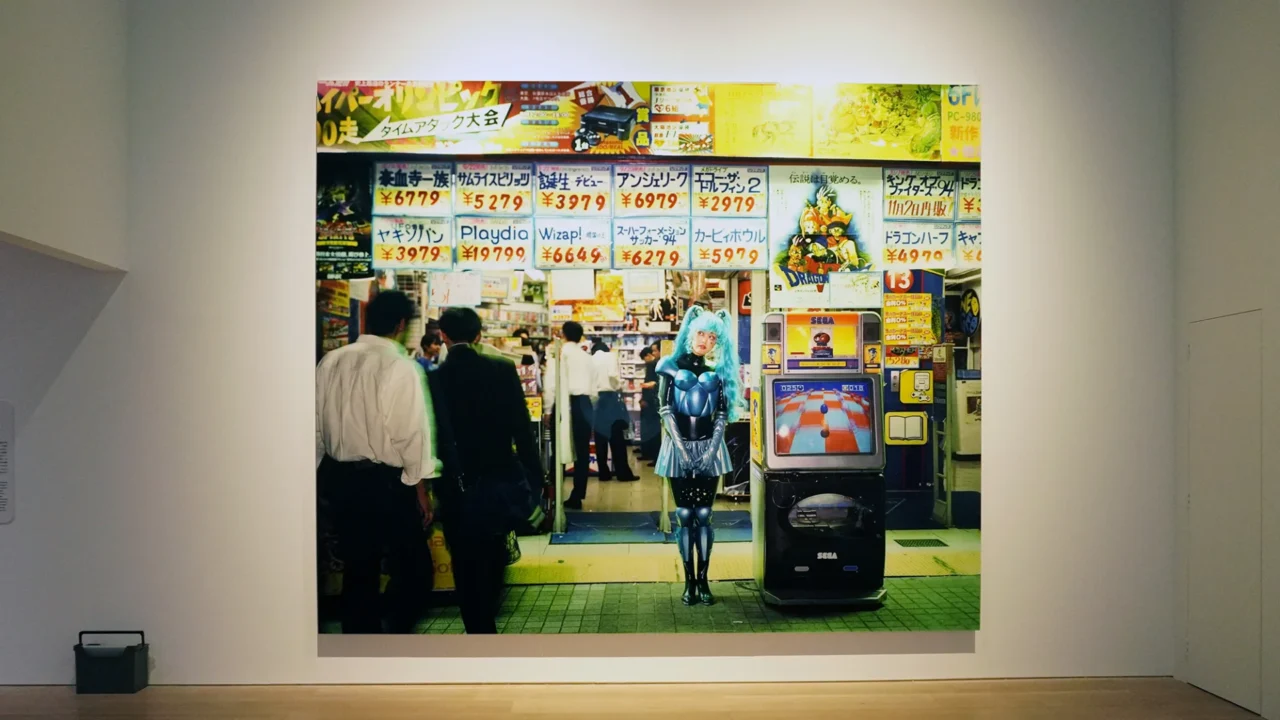
The exhibition unfolds in roughly chronological order. In Play with Me (1994), Mori stands outside a video game store in a sci-fi costume of her own design. Encountering these works from the 1990s brings a sense of nostalgia, but also raises a question: how different are they from the visual culture of today? Perhaps the imagery surrounding anime, video games, and cosplay has changed remarkably little over the past three decades. It is as though we have come full circle—or perhaps we have been standing still all along.
INDEX
Spirituality and an Experience That Changed Everything
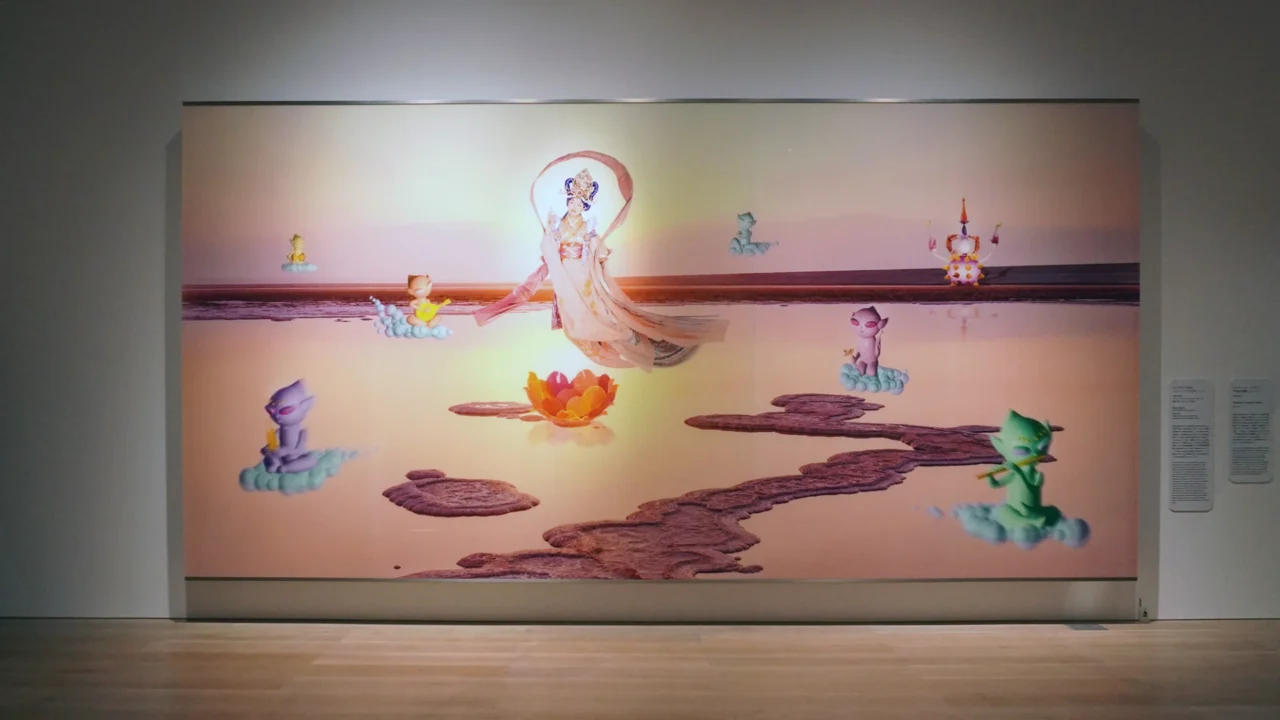
In the “Esoteric Cosmos” series (1996–1998) that follows, Mori draws on Buddhist imagery, transforming herself into deity-like figures that appear against remote landscapes such as the Dead Sea and the Gobi Desert. Figures and other imagery are digitally superimposed onto the landscapes, with multiple incarnations of Mori appearing within a single work.
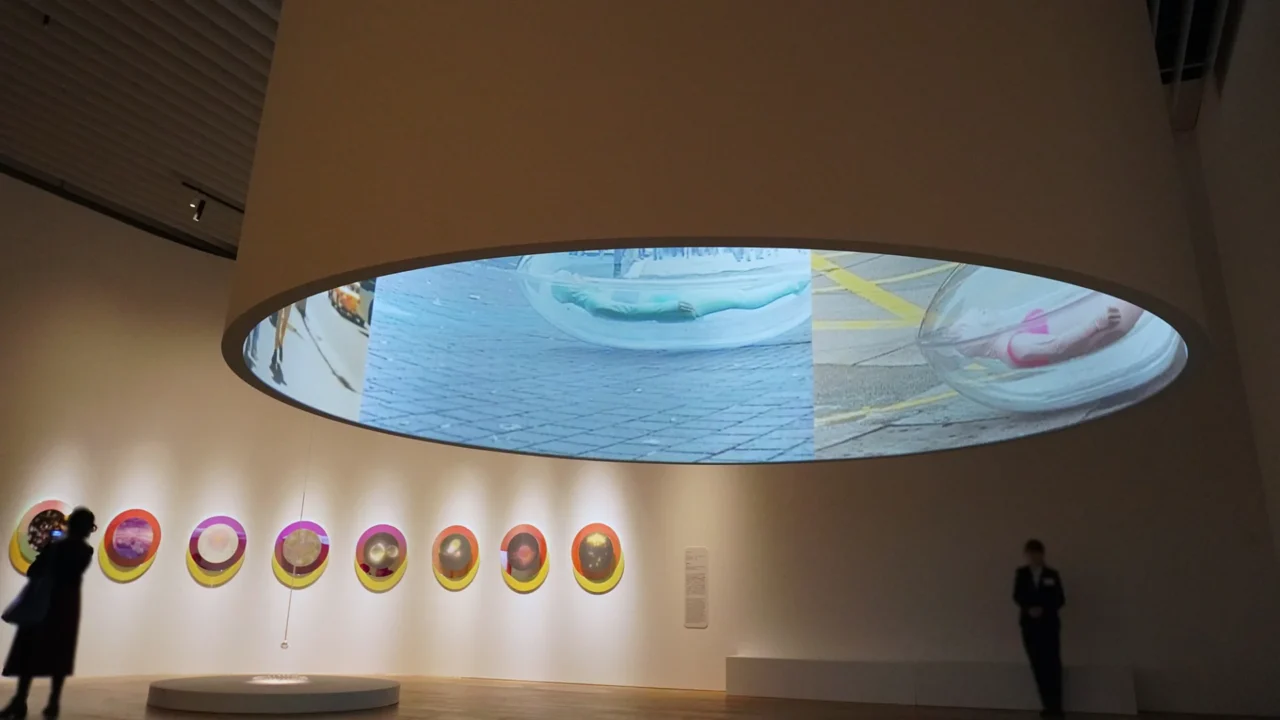
Moving through the exhibition, visitors enter a space bathed in soft white light. In the video installation Link (1995–2006), footage of Mori lying inside a transparent capsule in cities around the world is projected onto the interior of a large cylindrical structure suspended from the ceiling. The work brings together 13 locations across the globe, from Egypt, representing the past, to Tokyo’s Shibuya district, representing the present, and Shanghai and Dubai, representing the future. Here, time does not progress in a straight line from past to future but moves in cycles, echoing the Buddhist concept of reincarnation.
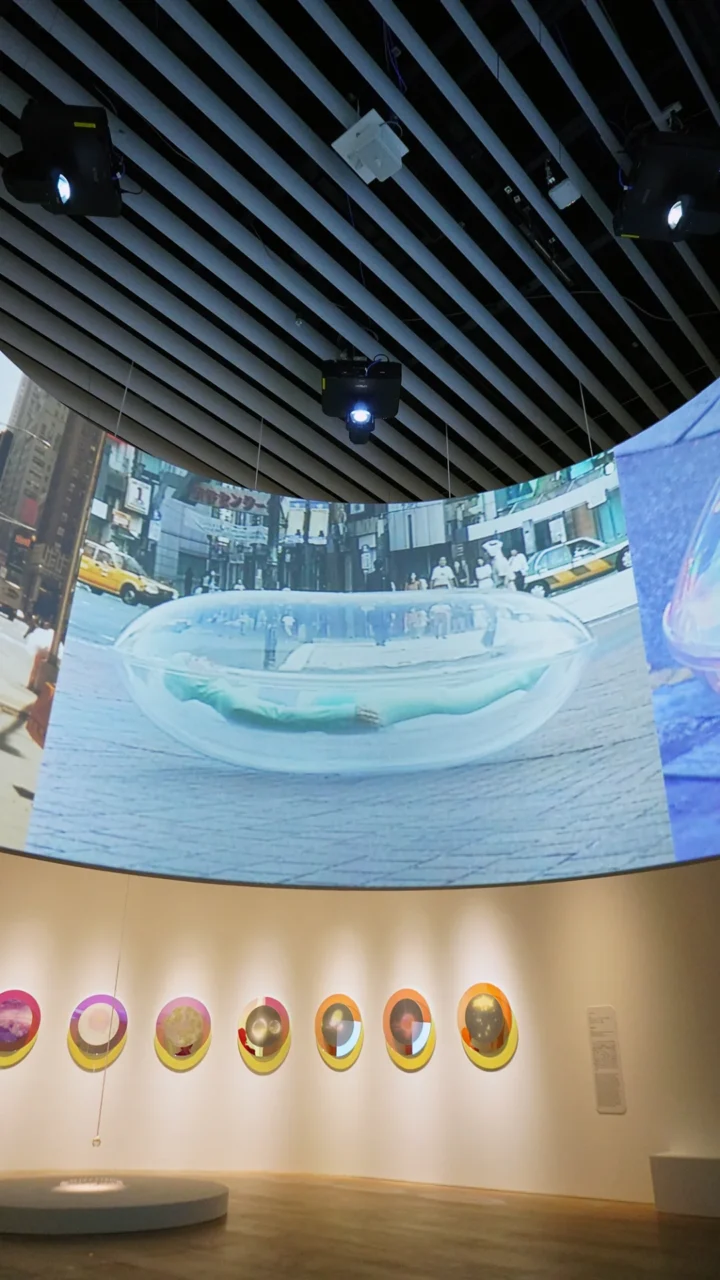
The same gallery also features video footage of Dream Temple (1997–1999), an architectural installation inspired by the Hall of Dreams (Yumedono) at Horyuji Temple. In 1998, while working on the piece, Mori reportedly had an extraordinary experience. While asleep, she was bathed in an intense light. Countless bubble-like spheres appeared before her, and she herself became one of them. In the distance was a central point radiating a powerful light. According to Mori, this was something distinct from a dream, an experience that brought an awareness of liberation from the ego and transcendence of the individual self. Ever since, she has lived in white surroundings and dressed in white.
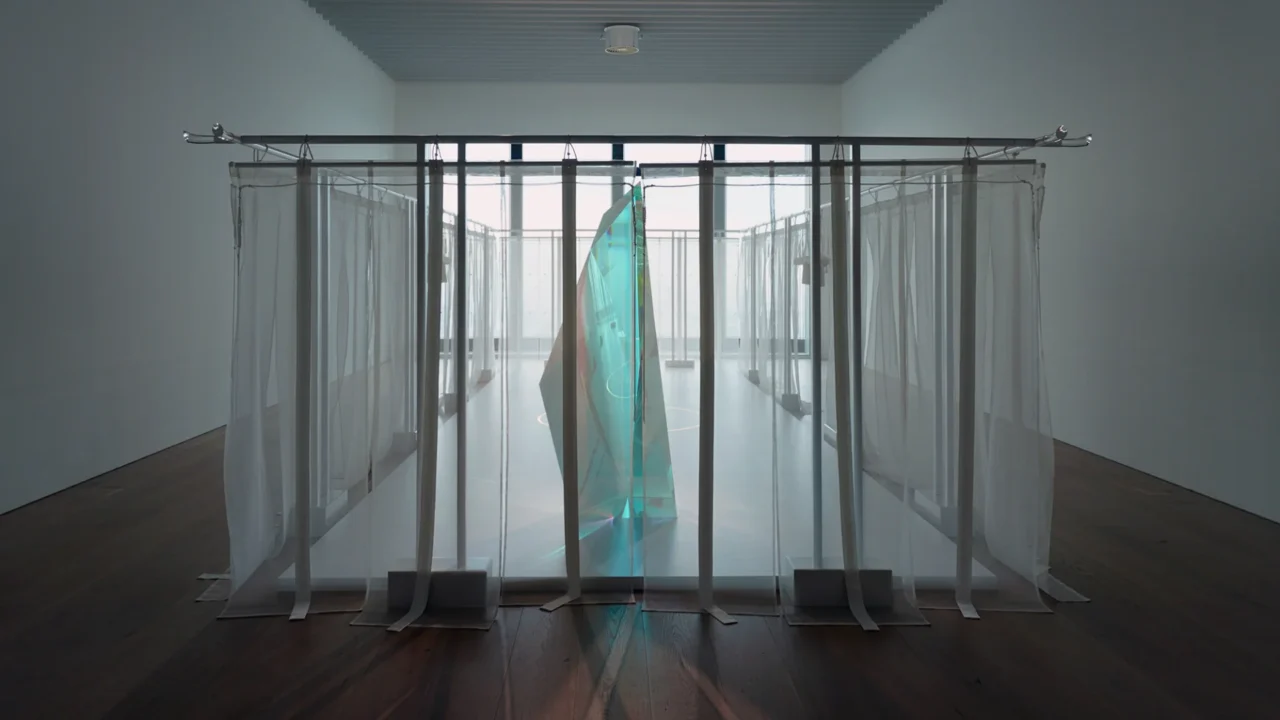
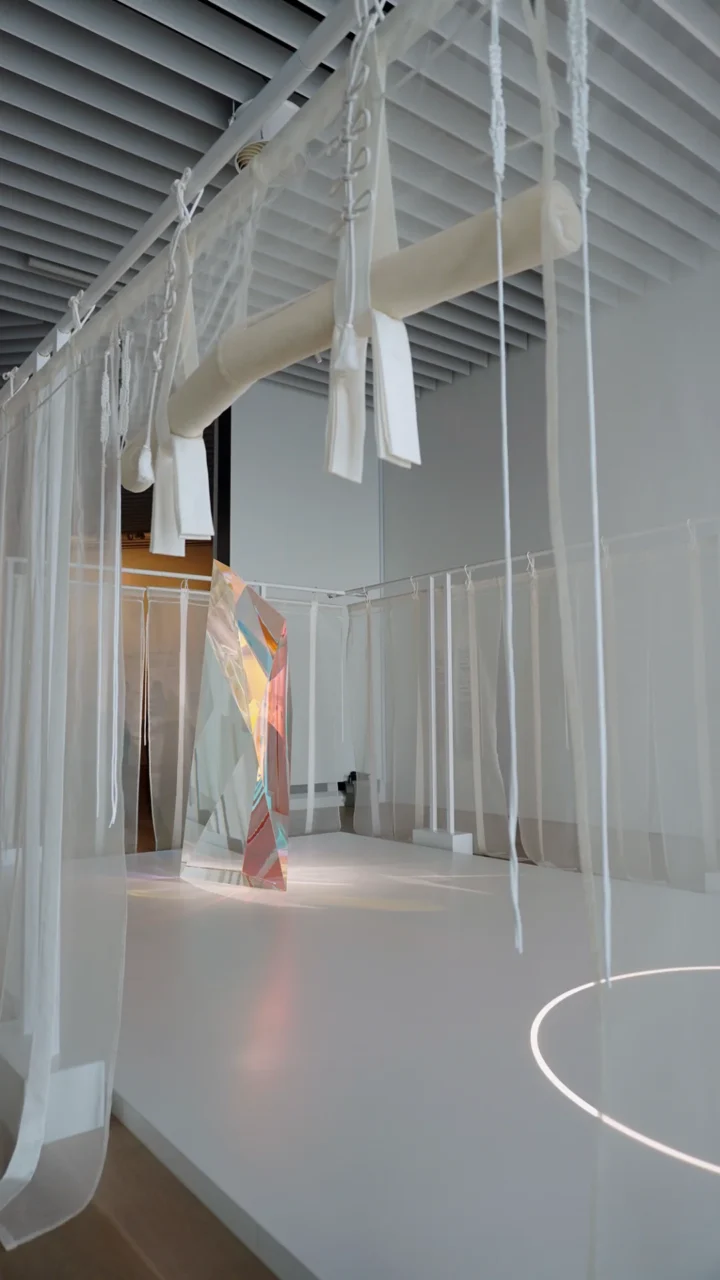
Around this time, her work grew increasingly abstract, with imagery of pale, white light becoming more prominent. Further along, in a gallery with windows overlooking the streets of Roppongi, stands one of her more recent works, O-Yashiro (2025). Surrounded by white silk curtains reminiscent of traditional Japanese partition screens known as kichō, acrylic stones modeled on actual rocks continually shift in color as they catch the natural light. A breeze from somewhere sets the fabric gently fluttering.
INDEX
Inside a UFO, Where the Self Begins to Dissolve
Then comes arguably the centerpiece of the exhibition: Wave UFO (1999–2002).
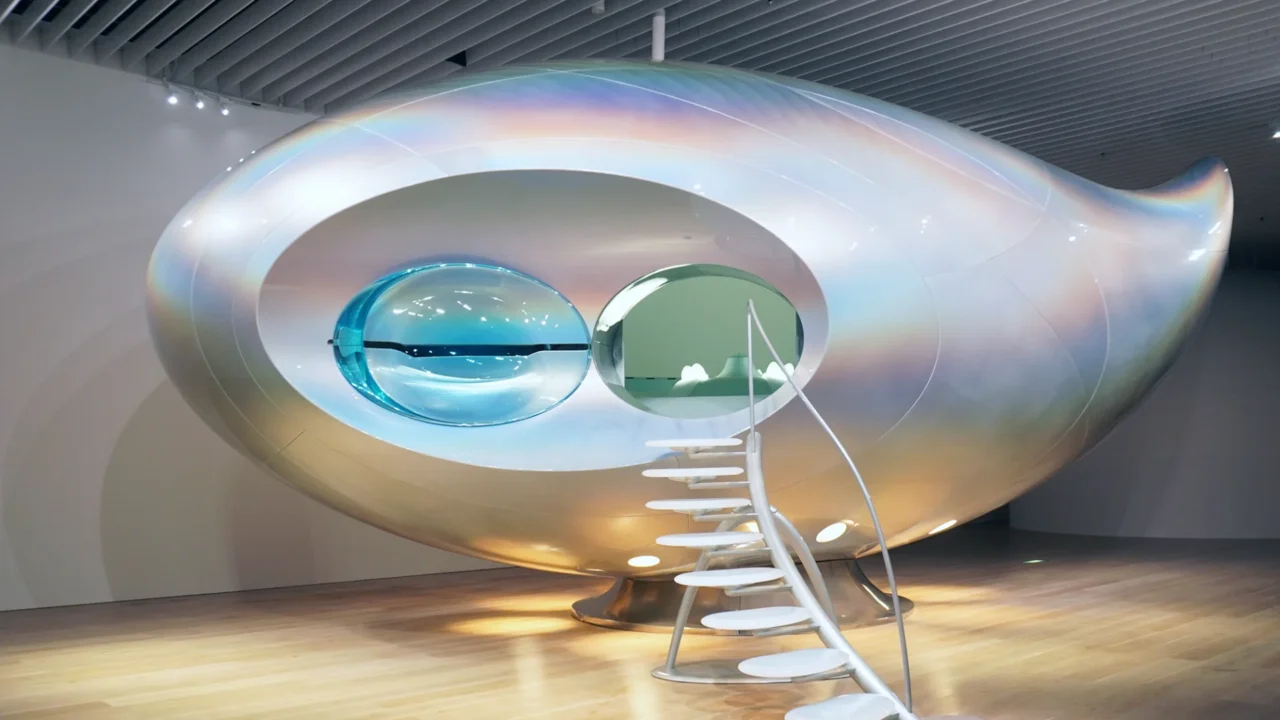
On loan from the Guggenheim Abu Dhabi, the work is being shown in Japan for the first time. With its streamlined form and iridescent glow, the enormous structure still looks futuristic more than two decades after its debut. Up close, its surface appears silver and remarkably smooth, giving little indication of whether the object is heavy or light.
Three visitors enter the structure and have brainwave sensors attached to their foreheads and other areas. Their individual brainwaves are translated into real-time visuals projected onto the dome above them, followed by Connected World, a computer-generated film depicting the interconnectedness of consciousness. Although I was unable to experience the installation firsthand on the day of my visit, I was able to watch a simulation in an adjacent dome. Bubble-like clusters of light emerge, change shape, disappear, and reappear. Each seems to move independently, yet together they appear to form a single body of light. I imagine this is the same visual language as the light Mori experienced in 1998.
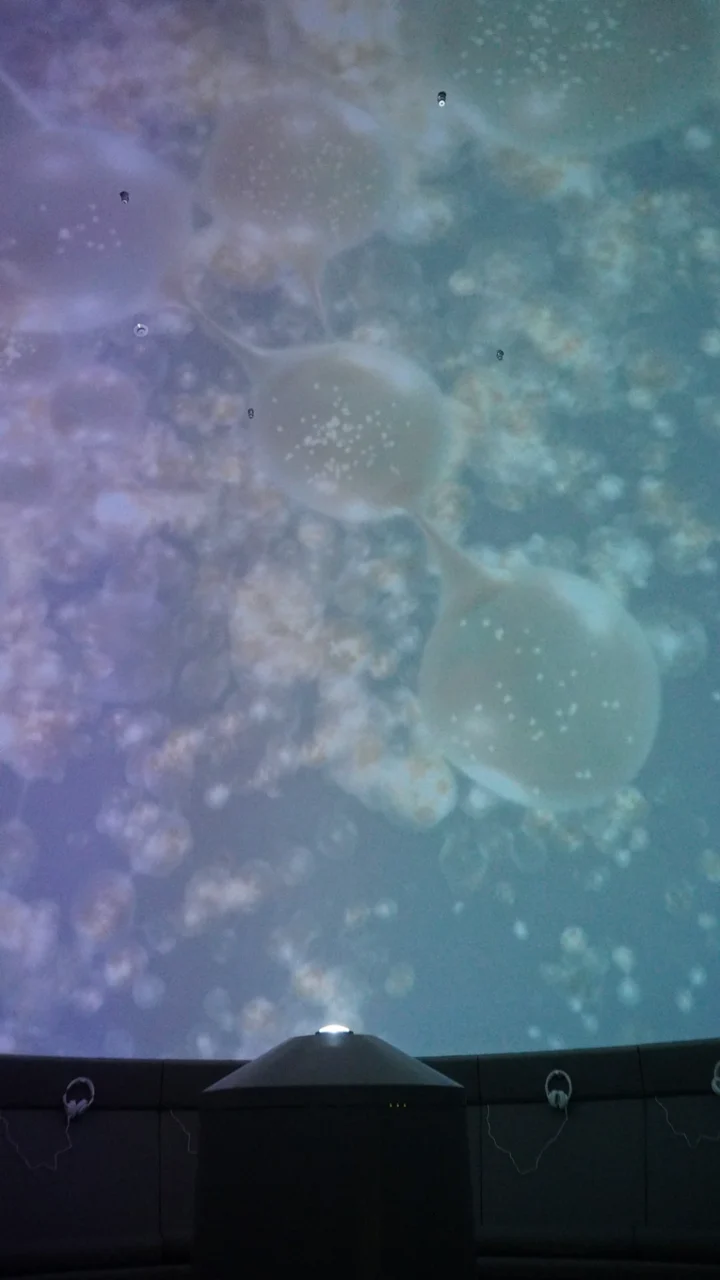
3人の異なる人物の脳波を、ひとつの映像空間に可視化するというアイデアは、サイボーグのように人間を技術The idea of visualizing the brainwaves of three different people within a shared visual space marks a departure from the cyborg-like vision of extending the human body through technology. Rather than enhancing the individual, the work seeks to blur the very boundaries of individuality. Apparently, the installation is designed to display a ring when the alpha waves of all three participants synchronize, though this has reportedly never happened.
The next gallery features drawings and working notes. In a notebook dating back to 1996, a single sentence appears on an otherwise blank white page: “Everything is connected.”
INDEX
Not What We Become, but What We Belong To
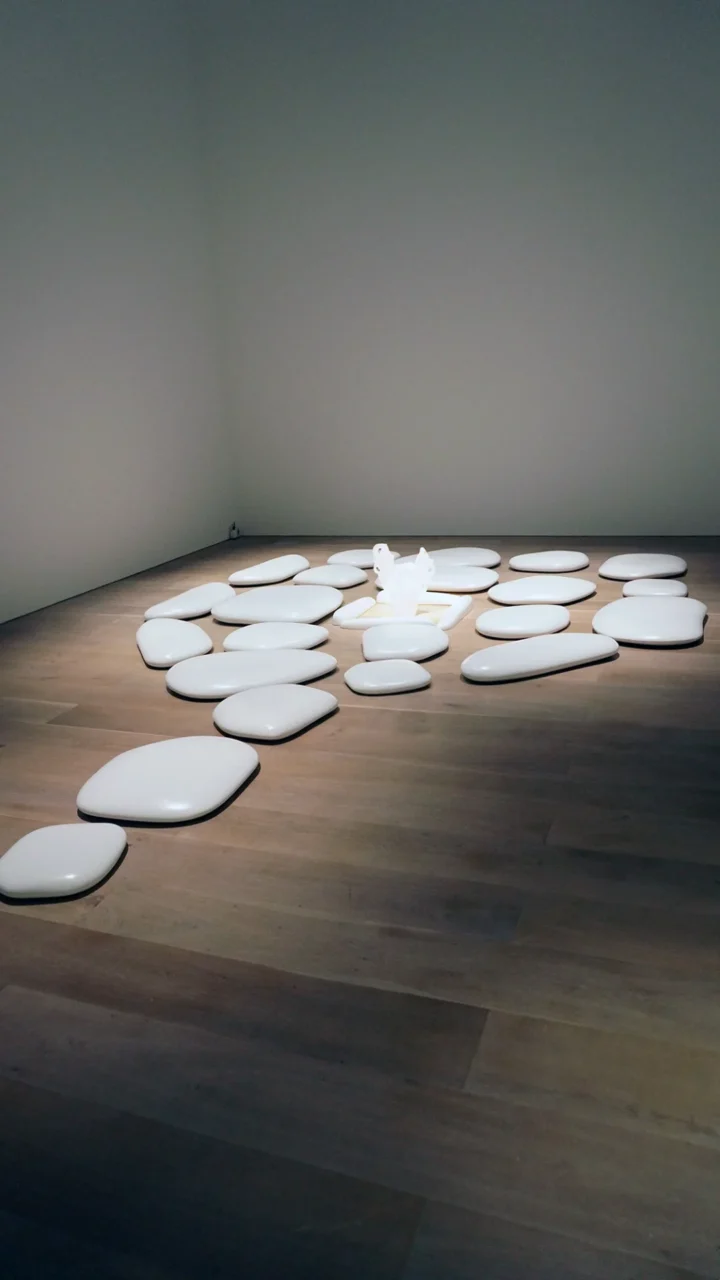
The exhibition continues with a section titled “Primal Memory,” featuring works that grew out of Mori’s research into the Jōmon period and ancient archaeological sites. Around 2003, Mori began visiting Jōmon sites across Japan. She recalls being unable to stop trembling when she set foot inside the Oyu Stone Circles in Akita Prefecture. Flat Stone (2006) is one of the works inspired by these ancient sites.
Standing in a pitch-black gallery is Tom Na H-iu (2006), a sculpture more than three meters tall that glows faintly and irregularly from within. Its light responds to data on neutrinos, tiny elementary particles detected by the Super-Kamiokande observatory in Gifu Prefecture. The title derives from a Celtic term for a place where the souls of the dead return. Neutrinos are also produced during supernova explosions. The work draws a parallel between the cosmic cycle in which the death of a star gives rise to new life and the rebirth of the soul.
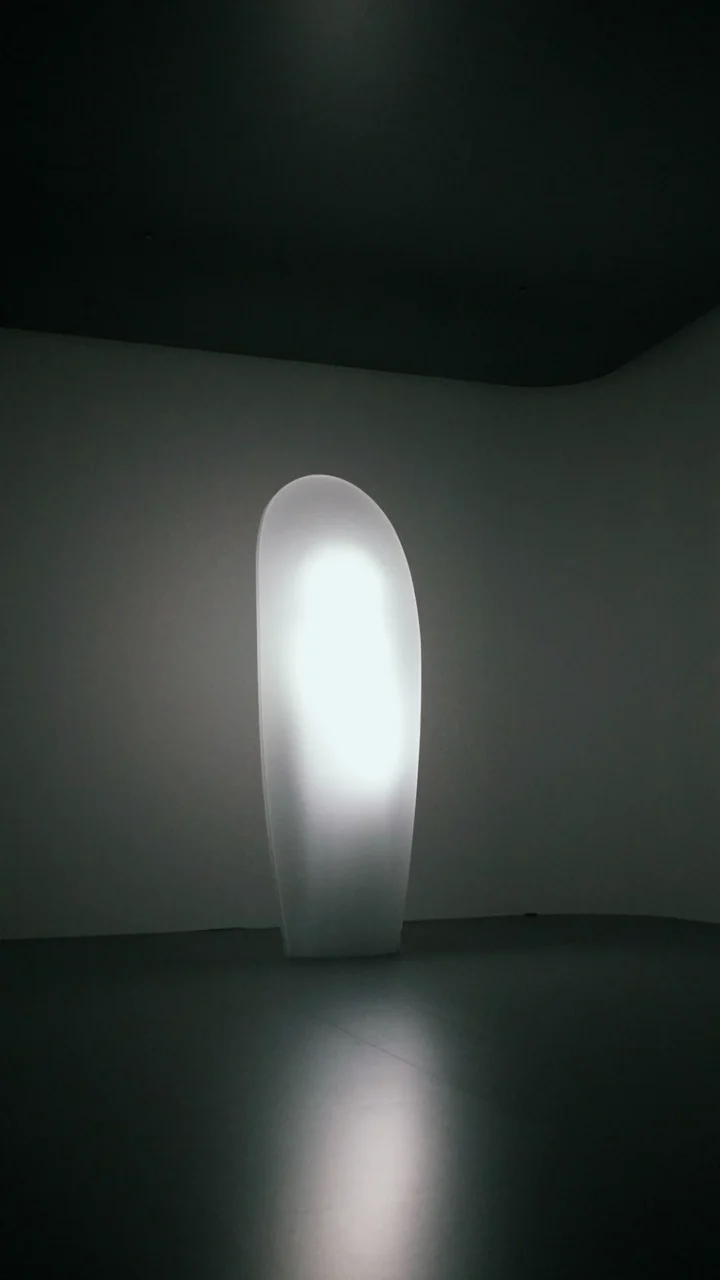
Glowing faintly in the darkness, the “stone” seems almost alive, its light swelling and receding like a breathing organism. The pauses are never quite long enough to suggest that the light has gone out for good, yet there is no discernible rhythm. Countless events are unfolding across the universe, far beyond what we can comprehend. Some reach us in the form of tiny particles called neutrinos. The unpredictable pulses of light seem to remind us of the limits of trying to make sense of such an extraordinarily complex world through a fixed set of rules.
If Mori’s works of the 1990s asked what humans might become, the question has now shifted to what larger whole we belong to. This shift resonates with debates around the posthuman, which have gained renewed attention in the age of AI. Mori herself may not have consciously engaged with posthuman theory in creating her works. Yet her artistic practice, attuned to the changing times, resonates deeply with the questions raised by philosophers. From cyborgs to the Jōmon period and the cosmos, Mori connects these seemingly disparate subjects through a single, enduring inquiry into where the boundaries of the human lie.