INDEX
Common Elements between the Rise of Digital Design in the 1990s in the U.S. and the Era of Generative AI
Hirano: To start, I’d love to hear your overall thoughts on the studio. Reflecting on this experience, I’m reminded of the paperless studio that Bernard Tschumi initiated at Columbia University in New York during the 1990s. It was an experimental space in architecture education, where new digital technologies, such as Hollywood special effects, were applied in an attempt to shape “new architecture.” A similar energy seems to be unfolding in this studio, and I have a feeling something fresh is about to emerge.
*Bernard Tschumi: A Swiss-born architect and theorist, Tschumi is known for his groundbreaking design philosophy, which blends architecture with philosophy, literature, and film theory. He reimagined architecture as not just a static space, but a dynamic “arena of events,” becoming a key figure in the Deconstructivist movement.
The Paperless Studio: A concept introduced at Columbia University’s Graduate School of Architecture (GSAPP) in the 1990s, where computers were used to replace manual drafting and explore new possibilities in design. Though some critics viewed it as diminishing the importance of hand-drawn sketches, today, with digital design being dominant, it’s seen as an innovative breakthrough in architectural education.
Kuma: When Bernard Tschumi launched the Paperless Studio, the reaction was one of shock and disbelief—people thought, “This person is doing something outrageously unconventional.” At the time, architecture still held tightly to the belief that true value existed in tangible buildings—what we understood as “reality.” Tschumi, on the other hand, was diving into a world with no physical reality, where everything existed solely on a screen. It felt like he was being met with skepticism from all sides. Yet, in today’s world, the tables seem to have turned. There’s an undeniable feeling that society can no longer function without AI, and that growing sense of urgency is fueling its creation. Comparing the 1990s with the 2020s reveals both echoes of the past and stark contrasts. In the past, architectural practices demanded a minimalist approach—everything had to be stripped down to meet the standard. That’s why the “excess” in everyday life that Hirano speaks about seemed at odds with architectural studios.
However, this studio challenges students to embrace that very “excess.” Watching their work unfold, I saw how seamlessly today’s architecture students are adapting to AI, without hesitation. Their daily lives are already surrounded by a constant overload of images and technologies. “How to ride the wave” of this excess has become second nature to them, and it feels like projects like this are simply an extension of that. The mindset in this studio is the complete opposite of the traditional “reduce everything” approach of typical architectural studios, and the students seemed truly invigorated by it.
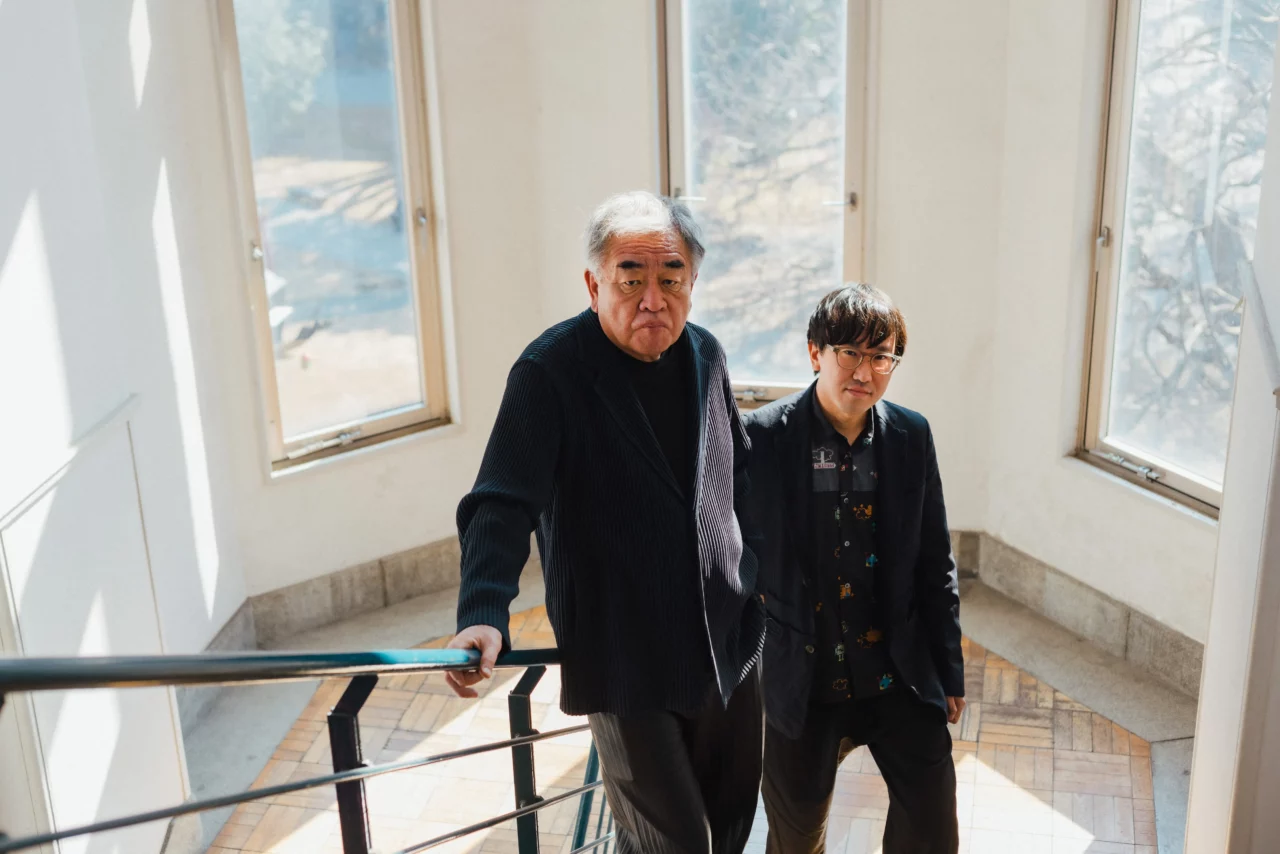
Born in 1954. In 1990, he founded Kengo Kuma & Associates. After serving as a professor at Keio University and the University of Tokyo, he is now a Special Professor and Honorary Professor at the University of Tokyo. Projects are currently underway in over 50 countries. He proposes architecture that explores a new relationship between nature, technology, and humans. His notable publications include Kengo Kuma: Onomatopoeia, Architecture, Grounding (Exnarex), Japanese Architecture (Iwanami Shinsho), All Works (Daiwa Shobo), Points, Lines, and Planes (Iwanami Shoten), Architecture That Loses (Iwanami Shoten), Natural Architecture, Small Architecture (Iwanami Shinsho), and many others.
Toshiki Hirano (right in the photo)
Born in 1985. Graduated from the Department of Architecture at Kyoto University in 2009. After completing a master’s degree at the School of Architecture, Princeton University in 2012, he worked at Reiser + Umemoto. He earned his Ph.D. from the University of Tokyo’s Department of Architecture in 2016. After serving as an assistant professor, he is currently in his present position. Specializing in architectural design and theory, he explores new aesthetics in architecture through the use of digital technologies and interdisciplinary discussions with fields like art and philosophy. Since 2020, he has served as a special lecturer at SEKISUI HOUSE – KUMA LAB, a part of the International Architecture Education Hub, a comprehensive lecture course within the University of Tokyo’s Comprehensive Project Office. His works include Reinventing Texture and Ontology of Holes. He has also edited a+u May 2017 Issue: Young American Architects (guest editor), among others.