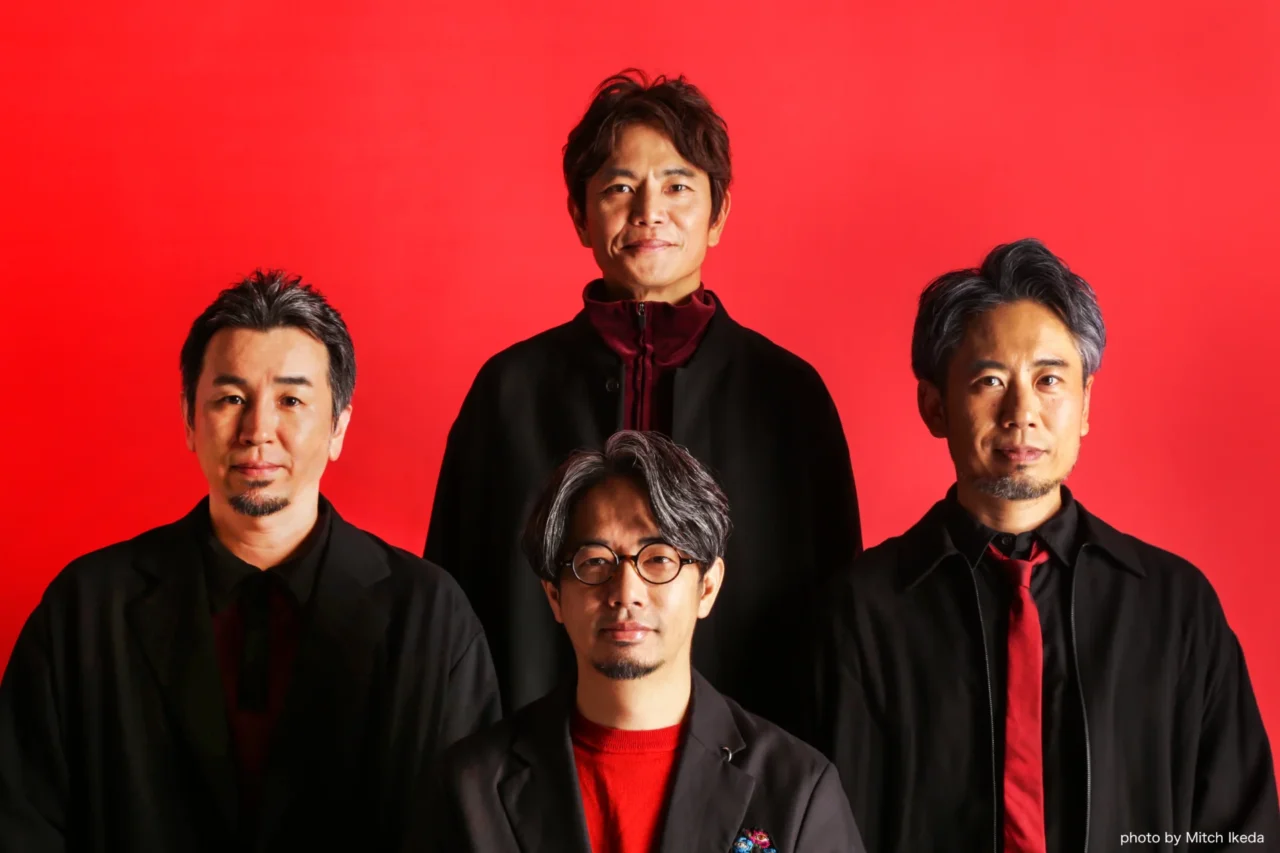
In the fall of 2001, in the historic city of Nara, a rock band named LOSTAGE quietly came into being. Now, their story unfolds on screen in the documentary A DOCUMENTARY FILM OF LOSTAGE – Hikari no Machi, Watashitachi no -.
LOSTAGE has always gone their own way—selling CDs and records only by hand or mail order, sometimes traveling across all 47 prefectures to share their music, living entirely through it. Since In Dreams (2017), their deliberately “closed-off” approach has taken on an almost uncanny presence in today’s world, where streaming has made instant access to music the default.
To mark the film’s release, NiEW sat down with the band’s driving force, Takahisa Gomi (Vo, Ba), to explore the visceral pulse of LOSTAGE’s music and the uncompromising values behind it—shedding light on a truly radical approach to making art.
INDEX

Formed in Nara in the fall of 2001, LOSTAGE is now celebrating its 25th year. Most of their music is not available on streaming services or digital platforms, and they avoid major distribution channels entirely. Instead, their releases are sold exclusively at THROAT RECORDS — the record store managed by vocalist Takahisa Gomi — through its physical shop, online store, and at live shows, with total CD sales surpassing 50,000 copies.
Selling Music by Hand and Online: The LOSTAGE Way
Looking back on the eight and a half years since In Dreams, how do you feel about the band’s activities? It seems like the band’s situation has also changed over time — what’s your take on that?
Gomi: I definitely feel the downsides of keeping our activities “closed off.” But it’s impossible to have everything, right? If you want to gain something, you have to sacrifice something else. There’s no doubt we’ve lost things by keeping to ourselves, but I think it’s fine if someone else picks up what we’ve left behind—we don’t have to do everything ourselves.
If that leads to someone else doing something, making music more interesting, and everyone pursuing their own way, I think that’s the ideal. And if you want to stay closed off, that’s fine too—I still view doing what you want within that space as something worth affirming.

In the documentary, there’s a scene around the time you released CONTEXT (2011) on your own label where you talk about wanting to “make a living from music.” How has your sense of that changed since then?
Gomi: When I think about “making a living from music,” the first question is: what are we even selling? On the surface, people buy concert tickets, CDs, or subscribe to streaming services, and it feels like they’re paying for music itself—but in reality, they’re exchanging money for something else.
For example, they’re paying for the CD as a container, or for the experience of a live show. Strictly speaking, that’s not music itself. So when I say “selling music,” I really mean selling something that isn’t music.
To put it bluntly, I don’t think you can actually sell music. Trying to sell something that can’t be sold borders on a kind of fraud—you say, “Give me money for this,” but since there’s no tangible form, you put it in a container, offer an experience, or use other methods to make it feel like you’re selling music.
You absolutely have to understand that. Music itself can’t be sold, so you have to create a way to sell it through storytelling that makes people feel good, satisfied, and like they’re sharing the same “lie,” and that it was worth it. That, I think, is what it really means to make a living from music.
Sharing the same “lie” to sell something as intangible as music.
Gomi: Maybe calling it a “lie” is a bit misleading. Take Mickey at Disneyland, for example — it’s not real. It’s just a costume. But everyone watching feels moved, excited, or happy. People know it’s not real, but they go along with it. Music is similar in that sense. I think those who sell music, especially, need to be more aware of what they’re actually doing.
This realization came from my own experience — ordering CD presses from a manufacturer, standing at the shop counter, hand-selling at live shows without going through distribution—and constantly thinking about, “What exactly am I selling?” I’m sure this perspective will evolve over time, but misunderstanding what you’re actually selling can be a serious problem.
INDEX
Getting Closer to Music Before It’s Something You Sell
There are many ways to describe it: a lie, entertainment, a dream, a story. When it comes to sharing something to “sell” music, which can’t truly be sold, what do you keep in mind?
Gomi: For us, it’s about scale and closeness. You could call it “being able to see the faces” or “being within reach.” It’s a distance where both sides can understand each other — like, “this isn’t working” or “this is art.”
I don’t think there’s anything inherently wrong with filling a dome with tens of thousands of people, selling tens of thousands of CDs, or racking up hundreds of millions of streams. But if you can’t see anyone, if all you have are numbers to measure people, it becomes really hard to share values.

That sense of scale and closeness itself upholds LOSTAGE and its music.
Gomi: I feel that if you can share values at the right distance, even when money is involved, you can still understand each other. For me, that exchange of feeling, that communicative aspect, is what matters most.
I think there was something before it was even called music — a feeling of “This is where I am” or “This is what I feel,” with melody and rhythm simply attached. There’s a sense of wanting to get back to that state, before music became a product. Even if there’s a contradiction in selling it, I don’t want to forget that music was originally like that. I want to stay oriented toward that feeling.
When we started the band, it was the same—more communication than ambition, more play than business. We’d look for friends in the same grade who could play instruments, talk about the music we loved, rent a studio with pocket money. That hasn’t changed. LOSTAGE still exists in that spirit, like gathering on weekends to play mahjong. It started as communication, and somehow, by luck, it’s become something people can listen to—a small creation born from that exchange.
INDEX
When Music Gets Caught in the Numbers Game
This documentary takes as one of its central themes the question of how music is delivered. Watching LOSTAGE’s activities in the film, you can’t help but feel a sense of unease about a society that seems to equate value with numbers — through streaming, YouTube, or social media — and operates on the assumption that bigger is inherently better.
Gomi: The world itself can’t function without those systems, and resisting decisions made by numbers is basically impossible. That said, I still feel a strong discomfort with the idea that everything can be measured numerically. There’s a real burden in constantly counting based on the assumption that bigger is better.
In the film, you also mentioned that “there’s no answer to why more people listening would be better.”
Gomi: Take a song that’s only been played three times — does that make it “bad”? You can’t really know. You don’t know the feelings behind those three listens. The weight of a single CD, the care in each encounter, gets lost, and it feels strange to act as if it doesn’t matter who listens or how, as long as the numbers climb and it “goes viral.”
The world is moving in a bizarre direction, and everyone is stepping onto the same scoreboard. You feel the discomfort, yet you still play the numbers game because, well, that’s just the way it works. Even knowing that winning or losing in that game has nothing to do with music, when it’s your turn, the pressure hits like, “Do I really have to roll the dice?” Hand-selling CDs isn’t the ultimate answer, of course — but maybe it’s healthier to imagine other ways to share music, ways that honor the experience rather than the count.

Even if some form of “exchange of feeling” exists through streaming, the way music is listened to has changed, and the logic of numbers increasingly dictates what’s considered good or bad in music.
Gomi: Sometimes younger bands come to me, trying to put into words that they want to follow a path like ours. They’ll say things like, “We made a CD… but we’re not sure how to get it out there,” and come by the shop.
It makes me really happy to know they’re paying attention to what we’ve done. But it’s incredibly hard for an unknown band to spread their music, so I always tell them they should definitely put it on streaming. I know that’s probably not the answer they wanted to hear when they came to me.
※The shop he’s referring to is THROAT RECORDS, the record store Gomi runs in Nara.

Gomi: I don’t think anyone can — or should — do things exactly the way we do. It wouldn’t make sense. If I were 18 and starting a band today, I’d put everything on streaming right away, maybe release a bunch of songs at a crazy pace.
Even before the film was made, I was thinking: it’s not about copying our approach. I hope people take the idea behind it and apply it in their own way. If someone came to me asking what to do, and I just told them, “Do it like this,” nothing new would come of it. I hope that’s the part people get from watching the documentary.